
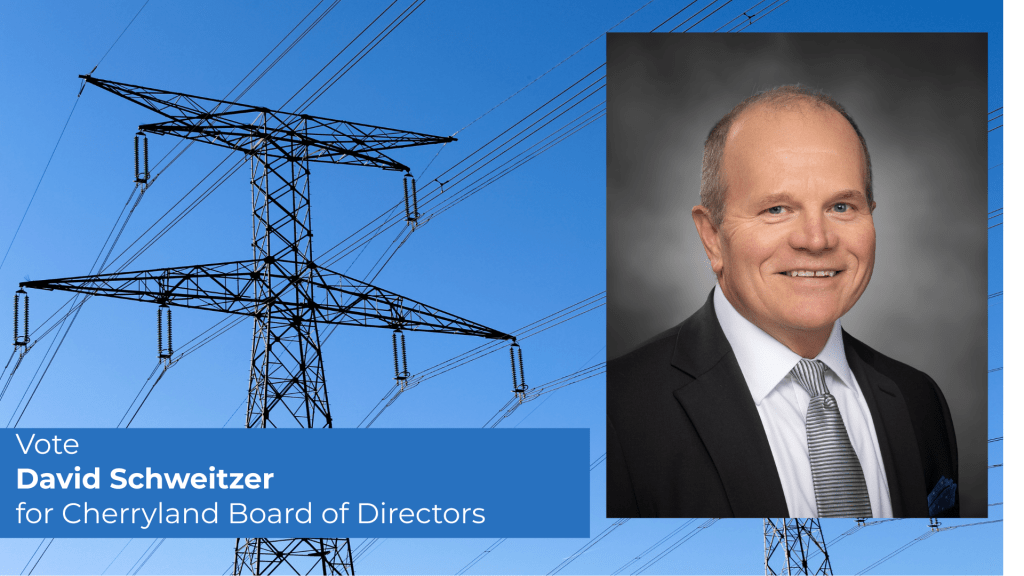
A little bit about me……
I was born in Detroit into a family of twelve (I’m number nine). After high school, I attended the University of Michigan and Lake Superior State University where I graduated with a degree in Finance and Economics. While there, I met my wife, Debra. We have been married for forty years and have two adult daughters, Nikki and Alex. I am a Chartered Financial Analyst (CFA) and have owned and operated Schweitzer Capital Group, LLC since 1996. I am an avid reader, enjoy physical fitness, and a passion for (and frustration with) golf.
My experience is vital to keeping our cooperative financially strong. Cherryland is consistently ranked among the best-managed electric coops in the nation, leading in key metrics such as equity management and the return of patronage capital to our members. Our operational reliability is equally impressive: our members’ lights stayed on over 99.9% of the time last year. This performance is no accident. Our commitment to hardening the grid through proactive tree trimming and undergrounding lines has protected our service territory during recent severe weather. Looking ahead, 2026 will be a pivotal year. The reopening of the Palisades nuclear plant will provide our members with constant, carbon-free electricity. By maintaining a diverse energy portfolio—including nuclear, natural gas, wind, solar, and coal for peak demand—we ensure a stable and affordable power supply for years to come. We also continue to make critical technological investments in cybersecurity, artificial intelligence, drones, and smart meters. In an increasingly fast-paced and complex environment, I am committed to upgrading our defenses to safeguard our members and the grid. As your representative on the board, I will work to provide safe, reliable, and affordable service to your homes and businesses. I bring no personal agenda—only a dedication to doing what is best for the members of Cherryland.
Experience is the foundation of a stable cooperative. I am confident that with continued steady leadership, Cherryland will navigate the challenges ahead successfully. Please take a moment to vote by following the easy instructions in the May Country Lines Magazine or at cherrylandelectric.coop. Your participation is essential to our success, and I would be honored to have your vote.

Current and Future Issues
Cybersecurity
While the primary fear is a physical blackout, modern cyber threats to our utility are multifaceted. Our adversaries (both criminal and state-sponsored) never rest. Beyond operational outages, we are the custodians of sensitive member information. We are only as secure as our weakest vendor. We scrutinize every software update and hardware component entering our network. Protecting personal and financial data is as critical to our trust-based mission as keeping the lights on.
We do not view cybersecurity as a “one-and-done” expense, but as a core operational requirement. We can never rest on our laurels because the technology used to attack us is evolving faster than ever. Artificial Intelligence has shifted the paradigm. AI allows bad actors to automate phishing at scale, create deepfake audio of executives to authorize transfers, and find software vulnerabilities in seconds that used to take months. To counter AI-driven attacks, we will continue to invest to safeguard our system.
The bottom line is that in the modern era, operational excellence is inseparable from cyber excellence. Our commitment to the membership is to ensure that as the bar for security rises, our investment, expertise, and vigilance rise to meet it. We are not just managing a grid; we are defending a digital frontier.
Data Centers
Data center headlines have become more frequent in the daily news cycle. As technology advances, so do the complexities of data center development. In my view, the industry will increasingly favor major metropolitan hubs as opposed to rural areas. For example, Texas and Viriginia currently lead the nation in data center construction due to energy access and federal government proximity.
Rural areas offer cheap land but face daunting hurdles that often outweigh the savings:
• Grid Connectivity: Regulatory delays can span years.
• On-site Power: The growing necessity for self-sufficient generation.
• Local Opposition: Rising community resistance to large-scale builds.
The following factors outline the critical shifts in data center design, construction, and recent regulatory events:
Water
• Closed-Loop Systems (The New Standard): Most new data centers utilize closed-loop liquid cooling. In these systems, water (or a coolant) recirculates indefinitely within sealed pipes. Aside from initial fill and minor “make-up” water for occasional maintenance, these facilities consume almost zero water.
• Evaporative Cooling (Legacy/Hybrid): Older or open-loop facilities use evaporation to reject heat. While this is highly energy-efficient, it does consume water. Many operators are now retrofitting these or using adiabatic cooling, which only uses water evaporation on the hottest days of the year, staying dry the rest of the time.
• Alternative Water Sources: Leading operators are increasingly using reclaimed or “purple pipe” wastewater for cooling, ensuring they do not compete with the local community for potable drinking water.
Ratepayer Protection
A significant shift in federal policy (March 2026) has addressed the cost-shifting concern—the idea that everyday residents might pay for the infrastructure needed by big tech.
• The Presidential Directive: Under the Ratepayer Protection Pledge, major hyperscalers (including Amazon, Google, Meta, and Microsoft) have committed to a “Build, Bring, or Buy” framework.
• Self-Funded Generation: Data center owners are now expected to fund 100% of the new electricity generation required for their facilities. This means they must either build their own on-site power (often small modular reactors or large-scale renewables) or sign long-term contracts that trigger the construction of new external plants.
• Infrastructure Costs: The pledge ensures that tech companies, not utility customers, cover the cost of transmission upgrades and grid interconnections required to serve their massive loads.
Efficiency Gains and Grid Flexibility
While the sheer volume of power needed is high, the efficiency per unit of compute has skyrocketed and will continue to do so. Data center owners have an incentive to lower their energy costs:
• Energy Density: AI-driven data centers are moving toward direct-to-chip liquid cooling, which is significantly more energy-efficient than traditional air conditioning.
• Load as an Asset: Modern data centers are becoming grid interactive. They can throttle their power usage during peak demand (like a heatwave) to help stabilize the grid, acting as a massive virtual power plant that prevents blackouts for residential customers.
• The DATA Act of 2026: Proposed legislation is further encouraging this by creating pathways for data centers to go entirely off grid, using captive power sources that bypass the traditional utility queue entirely.
Electric Vehicles (EVs 2.0)
The next generation of EVs promises to be the game changer that the first generation of (think lithium batteries) was unable to achieve. There are major developments in battery technology that could be the tipping point for EV acceptance by consumers. The transition from current lithium-ion (Li-ion) batteries to Solid-State Batteries (SSB) is being hailed as the “iPhone moment” for transportation. For those of us that had a Blackberry, it was the phone of the time. Its users were called “Crackberrys” due to their eyes always peeled to their phones (some things have not changed). But, overnight the iPhone rendered the Blackberry obsolete.
While Li-ion moved the needle, it brought “BlackBerry-style” compromises: slow charging, cold-weather range loss, and thermal stability concerns. EV 2.0 removes these friction points, turning the electric vehicle from a conscious choice into the obvious choice.
Key Advantages of Solid-State Technology
• Energy Density : SSBs can store up to twice the energy by weight compared to current batteries. This translates to 600+ mile ranges without increasing the car’s weight.
• Ultra-Fast Charging: Because solid electrolytes are less prone to overheating, they can handle higher voltages. We are looking at 10-minute full charges, approaching the time it takes to fill a gas tank.
• Safety (Non-Flammable): The liquid electrolyte in current EVs is flammable. Solid-state materials are inherently stable, virtually eliminating the risk of “thermal runaway” or battery fires.
• Longevity: SSBs are more resistant to “dendrites” (microscopic spikes that short out batteries). They are projected to last 5,000+ charge cycles, potentially outlasting the car’s chassis (up to 300,000–500,000 miles).
We are currently in a “wait and see” phase, but the tipping point is closer than most realize.
2024–2026: The Validation Era
• Pilot Programs: Automakers like Toyota, BMW, and Volkswagen are currently road-testing prototype SSB vehicles.
• Semi-Solid State: We are already seeing “semi-solid” batteries (a hybrid tech) entering the market in high-end Chinese EVs (like NIO and Geely), offering 500+ mile ranges today.
2027–2030: The Mass Adoption Tipping Point
This is when the “iPhone moment” goes mainstream:
• Commercial Production (2027/28): Toyota and Samsung have targeted 2027 for the start of commercial SSB production. Initially, these will be in “halo” or luxury vehicles.
• Psychological Shift: Once consumers see a neighbor charge an EV in 10 minutes or drive from New York to Richmond and back on one charge, the range anxiety narrative will collapse.
• Cost Parity: By 2030, manufacturing scales are expected to bring SSB costs down to match current Li-ion levels. At this point, the resale value of EV 1.0 cars (liquid-battery) may drop, further accelerating the rush toward EV 2.0.
• Grid Stability: Because SSBs have a longer cycle life, they are perfect for Vehicle-to-Grid (V2G). These cars can function as premium battery backups for the home and grid without the owner worrying about “wearing out” their car battery.
• Cold Weather: Cold weather is actually where the EV 2.0 transition becomes most visible to the average driver. Tests show SSBs retaining 70-80% of their range in extreme cold, compared to the 50% or less seen in Li-ion models. Current EVs use a significant amount of their own stored energy just to keep the battery pack warm enough to function while parked. For the consumer, this means leaving their car at the airport in January and returning to find the same battery percentage they left it with.
The Bottom Line: EV 2.0 removes the geographic barrier to EVs. It turns the electric car from a “Sun Belt” luxury into a “Snow Belt” necessity.
The views expressed on this website are Dave Schweitzer’s and not necessarily those of Cherryland Electric Cooperative.


